FDOT Emergency Travel Alert: For information on the current situation, please visit the following page -

SR 80 (Southern Blvd) Bridge Replacement Project
District Office
Gerry O'Reilly
District Four Secretary
3400 W Commercial Blvd, Fort Lauderdale, FL 33309
Public Information Team
Guillermo “Billy” Canedo
Communications Manager
Tel: 954-777-4090
Guillermo.Canedo@dot.state.fl.us
Additional Contacts
Staff Directory
Project Resources
About the Project
Documents & Publications
Construction Updates

Email
FAQs
Construction Photos
Public Notices
Schedule
Travel Updates
*NOTICE*
Flagler Drive will be closed through summer 2023
Welcome
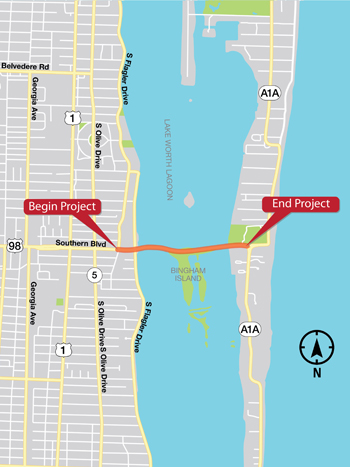
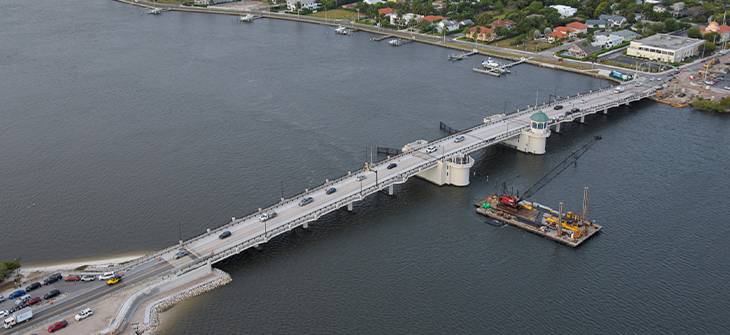
The Florida Department of Transportation will replace the SR 80/Southern Blvd. Bridges over the Intracoastal Waterway and Lake Worth Lagoon between West Palm Beach and Palm Beach. The new bridges will each carry one lane of traffic in each direction, have 6-foot-wide sidewalks in each direction, and 10-foot-wide paved shoulders with 7-foot-wide bike lanes. The new bridge over the Intracoastal Waterway will be a drawbridge with a vertical clearance of 21 feet and the navigable-channel width will be increased to 125 feet. The new bridge over Lake Worth Lagoon (tide relief bridge) will be a low level, fixed bridge similar to the existing bridge. The project also includes reconstruction and paving of the roadway approaches and causeway.
Project At-A-Glance
District
Four (South Florida)
Start Date
April 2017
Est. Completion Date
Summer 2023
Cost
$97 Million
Lengths and Limits
From Washington Rd to SR-A1A/South Ocean Blvd. (0.757 miles)
Contractor
Johnson Bros. Corporation
Project Manager
Bodler Barthelemy, P.E.
Bodler.Barthelemy@dot.state.fl.us